
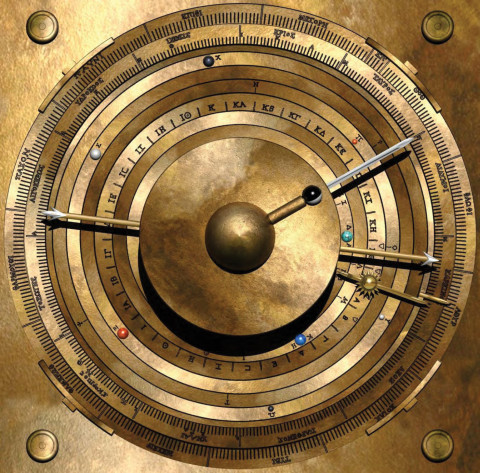
Of the many discoveries about the Ancient Greek world, none has perplexed experts as much as the Antikythera mechanism. The world's oldest analogue computer remained a mystery to the world for more than five decades after its discovery and it wasn't until a few years ago that modern technological advances managed to fully map its inner workings. Today we will look at the history of this mysterious ancient Greek artifact.
The Discovery
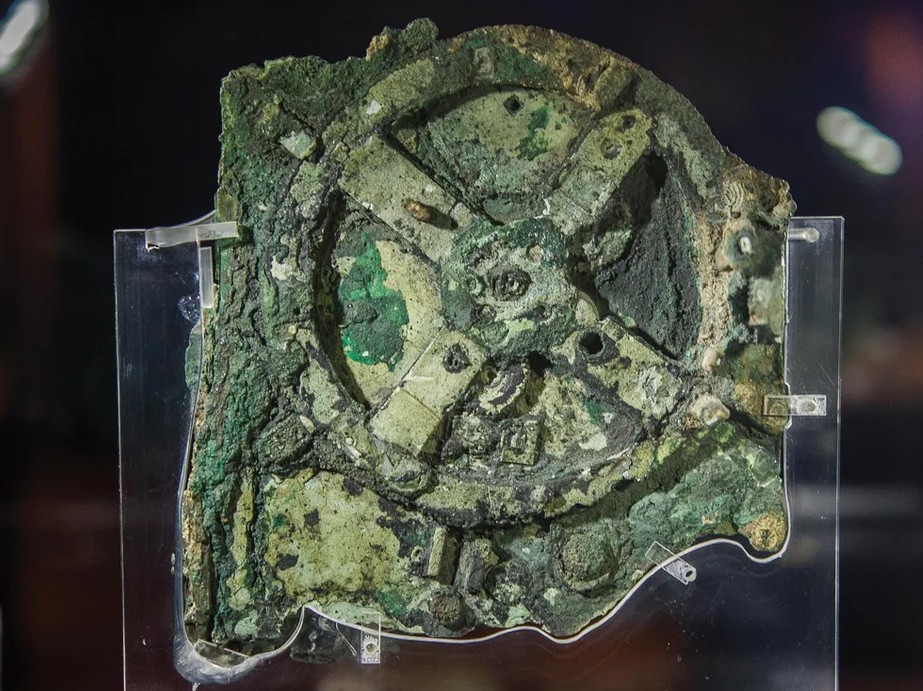
 In 1900 a storm forced two sponge boats headed back to the island of Symi from Tunisia to dock for safety in the port of Antikythera. This fortuitous incident led to one of the most significant archaeological discoveries of the 20th century. With the boats forced to stay ashore, one of the ships' divers, went under water to fish for the crew. When they pulled him up, instead of lunch he brought on board the arm from a bronze statue! The divers return to Symi, which was then still under Ottoman occupation, and informed the local authorities of their discovery, unsure of how to proceed next. It was Antonios Oikonomou, an archeology professor in the University of Athens who hailed from the island of Symi himself, who acted as an intermediary between the divers and the Greek government. This ensured the findings would not end up sold to smugglers but instead would remain under the auspices of the Greek government, which in turn begun retrieving artifacts from the wreckage at a slow pace. It wasn't until 1902 that an archeologist noticed that one of the artifacts salvaged seemed to feature a gear wheel and astronomical writings embedded on it, which begun a decades-long hunt for the purpose of the mysterious device.
Origins
To this day, the origins of the mechanism are uncertain and heavily speculated with a multitude of theories creeping up in the past decades. Experts taking into account its etchings, the type of ship that carried the mechanism as well as other findings that were uncovered in the Antikythera shipwreck, have placed the origin of the mechanism in the far reaches of ancient Greece, from Syracuse (now part of modern Italy) to Pergamon (now part of modern Turkey), as well as the Greek cities of Rhodes and Corinth. One thing all experts seem to be in agreement of, is that the sophistication of the mechanism indicates that it was not the first of its kind, and that prior models that have never been found must have preceded it. There are also multiple references of such devices in Greco-Roman literature of the era, particularly in the writings of Cicero. It is estimated to have been built some time in the 2nd century BCE. What seems eerily peculiar, is that a machine of similar complexity, making extensive use of gears, did not appear again for almost 1,000 years, with medieval cathedral clocks.
Purpose
 The Antikythera mechanism was an astronomical calendar of sorts, displaying the exact positions of the sun and the moon, predicting both solar and lunar eclipses and tracking the planetary motion of known celestial bodies like Mercury, Venus, Mars, Jupiter and Saturn. In addition, it served as a calendar, having marks for the 365-day Egyptian calendar model, it included marks for the Greek Zodiac signs and even featured a dial marking the four-year schedule of various Games of the Ancient World, such as the Olympic Games. Even though its function could be considered as an early navigation system to assist ships in their routes, leading scholars agree that it most likely served as a scientific teaching tool. It is true that its planetary tracking could be used in navigation, which might even partially explain it being on-board a ship, but this shoe-box sized computer was more likely a luxury item of the ancient world.
In Modern Times
The Antikythera mechanism has attracted a lot of interest from the scientific world ever since its discovery, and millions of hours of research have been devoted into gaining a deeper understanding of its inner workings. The level of sophistication exhibited in its epicyclic gearing widened our appreciation of the scientific understanding possessed by the ancient Greeks. Even during the 2020s, scientists are taking advantage of X-ray modeling technology to create a reconstruction of the mechanism's layout. Nowadays, the original gears of the Antikythera mechanism are part of the bronze collection of the National Archaeological Museum of Athens.